


LOCATION & DATE
Croatia
14. – 25. 9. 2027.
THE RACE
DISCIPLINES: Hike, MTB, kayak, packrafting, navigation, ropes
DISTANCE: 650 km
CATEGORIES: Mixed Teams of 4
TEAM LIMIT: 80 teams
WINNING TIME: around 100 hours
COURSE OPEN: 175 hours
LOGISTICS
Unsupported
Kayaks (provided by the organiser)
Packrafts (teams will bring their own)
MANDATORY EQUIPMENT: ARWS Standard list
RULES: Standard ARWS rules
PRIZES
Total prize money: 50 000 $
Prizes from our sponsors for top 3 teams

RACE CONCEPT
Every edition of Adventure Race Croatia explores a new part of our beautiful country. A team of four, including both men and women, will try to navigate their way from control point to control point in a number of disciplines. Disciplines include: mountain biking, trekking, kayaking and orienteering.
Adventure Race Croatia is somewhat different from most of the races in ARWS. Not to say that there is anything wrong with other races, but we prefer to have shorter stages and more of them. ARC will typically have between 14 -17 stage,s and hike stages will rarely be over 40 km, bike stages over 100 km and kayak stages over 40 km.
A lot of stages means a lot of transitions, so you can think of transitions as a separate discipline because you can lose a lot of time in them if you are not organised, prepared and efficient. So don’t forget to train transitions too.
- RUN/HIKE
- BIKE
- PADDLING
- ORIENTEERING
- ROPES
You can expect rocky terrain on this edition. Some of the trails will be marked and it will help you a lot with navigation. We tend to avoid paved and gravel roads as much as we can.
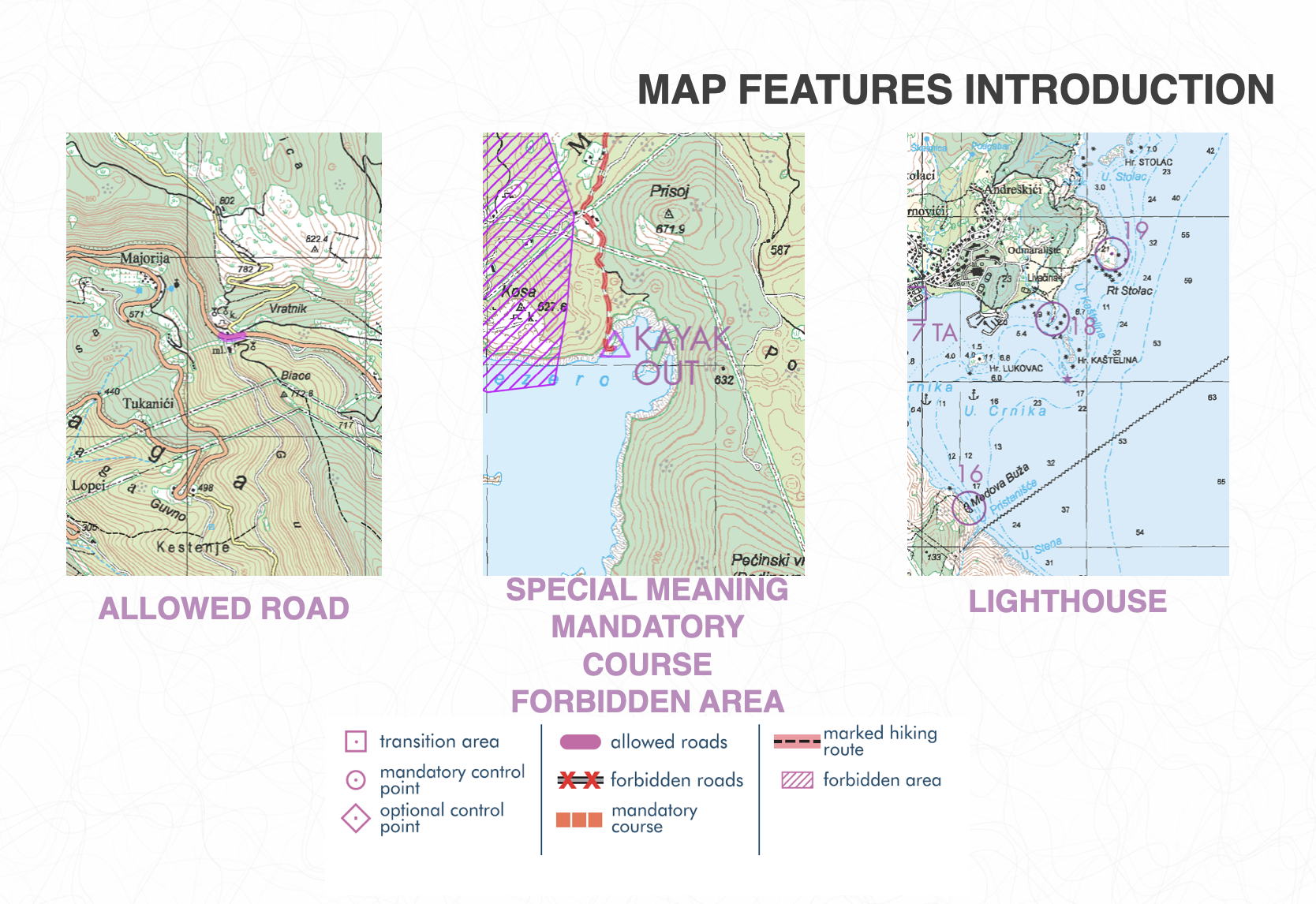
In national parks and nature parks, you are not allowed to hike outside marked paths.
Biking will be mostly done on gravel and forest roads. There will be some paved roads but we tend to avoid major roads. In fact most of the main roads are not allowed on our races (look at our maps from previous editions).
There will be some cool singletrack sections on some of the bike stages.
We suggest full – suspension bike but hardtails will work just fine. Tubeless tires are highly recommended.
Paddling sections can be on sea, rivers and lakes.
We will use plastic RTM Ocean Duo kayaks with seats and back rests for the sea sections and teams will use their own packrafts for river sections.
Teams will have to bring their own paddles and PFD’s and a kayak bag that can fit all the kayak gear including packrafts.
Probably one of the most important skill for an adventure race because you can be fast but if you are going in the wrong way, being fast means nothing. Orienteering will be not too demanding but you will be able to show your navigation skills and choose the right route.
Maps will be waterproofed but you will be able to write on them. Each team will get 2 sets of maps.
Map scale will be 1:25 000 or less on some sections. On some paddling stages the scale will be 1:50 00.
We might include top-rope climbing (easy grades), rappelling or via ferrata.
Expect some exhilarating scrambling for sure.
PADDLING
HIKE
BIKE
SCHEDULE
TUESDAY
14. 9. 2027.
-
Morning
Transfer from Zadar Airport
-
Afternoon
Transfer from Zadar Airport
-
10:00 - 19:00 | 20:00 - 22:00
Registration
TA boxes distribution
Equipment check-up
Photos in race bibs -
19:00
Dinner
WEDNESDAY
15. 9. 2027.
-
Morning
Transfer from Zadar Airport
-
9:00 - 16:00
Registration
TA boxes distribution
Equipment check-up
Photos in race bibs -
18:30
Dinner
-
19:30
Opening ceremony
THURSDAY
16. 9. 2027.
-
10:00
Race briefing
-
11:00 - 13:00
Maps
-
14:00 - 21:00
Drop-off bike boxes
Drop-off gear boxes
Drop-off paddle bags
Drop-off team bags -
18:30
Dinner
FRIDAY - THURSDAY
17. 9. - 23. 9. 2027.
-
Friday 4:00
Transfer to start
-
Friday morning
Start
-
Friday - Thursday
Exploring Croatia the hard way
-
Tuesday morning
First teams expected at the finish line
FRIDAY
24. 9. 2027.
-
14:00
Race ends
-
18:00
Dinner
-
19:00
Award ceremony
SATURDAY
25. 9. 2027.
-
Early morning
Transfer to Zadar Airport
The schedule is provisional and is subject to change.
EQUIPMENT
& RULES
ARWS Mandatory Gear

This is a standard ARWS mandatory gear list.
We added some of the items that you will need for this race.
Also we removed some of the items you will not need.
ARWS Rules

Standard ARWS rules apply for Adventure Race Croatia.
Any additional rules and penalties they might cause will be clearly explained and presented prior to the race.
Not knowing the rules is not an excuse for breaking them.
ADDITIONAL RULES FOR ADVENTURE RACE CROATIA 2027
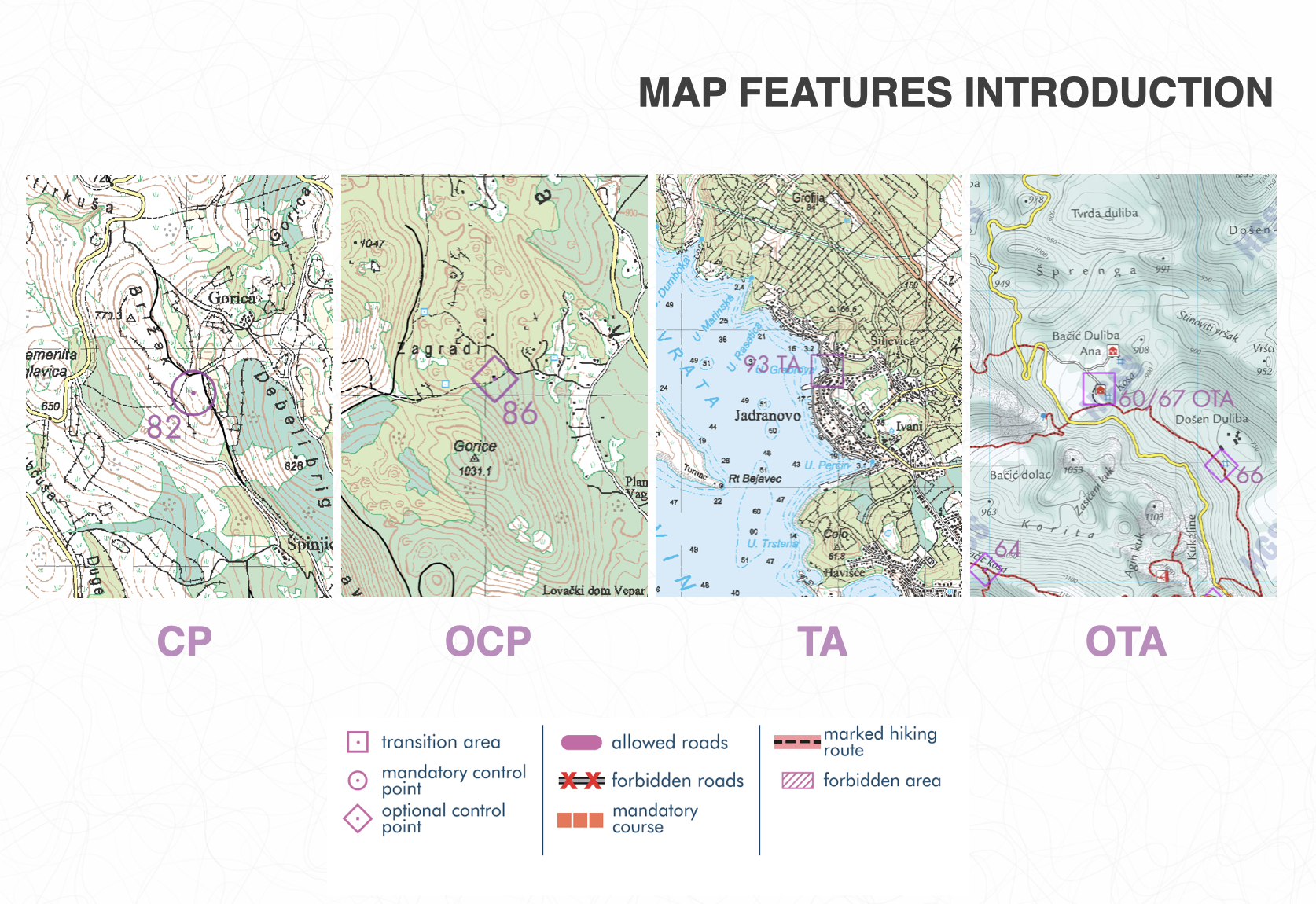
- There will be Mandatory and Optional Checkpoints . Read more about it in RANKING
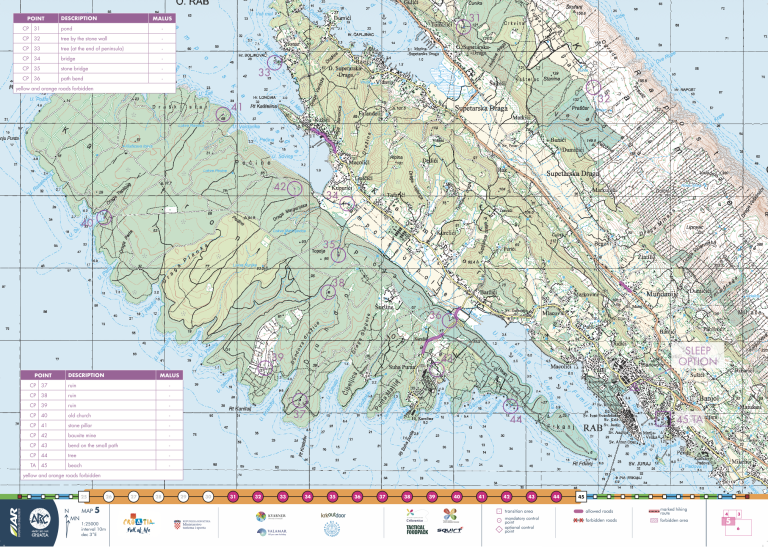
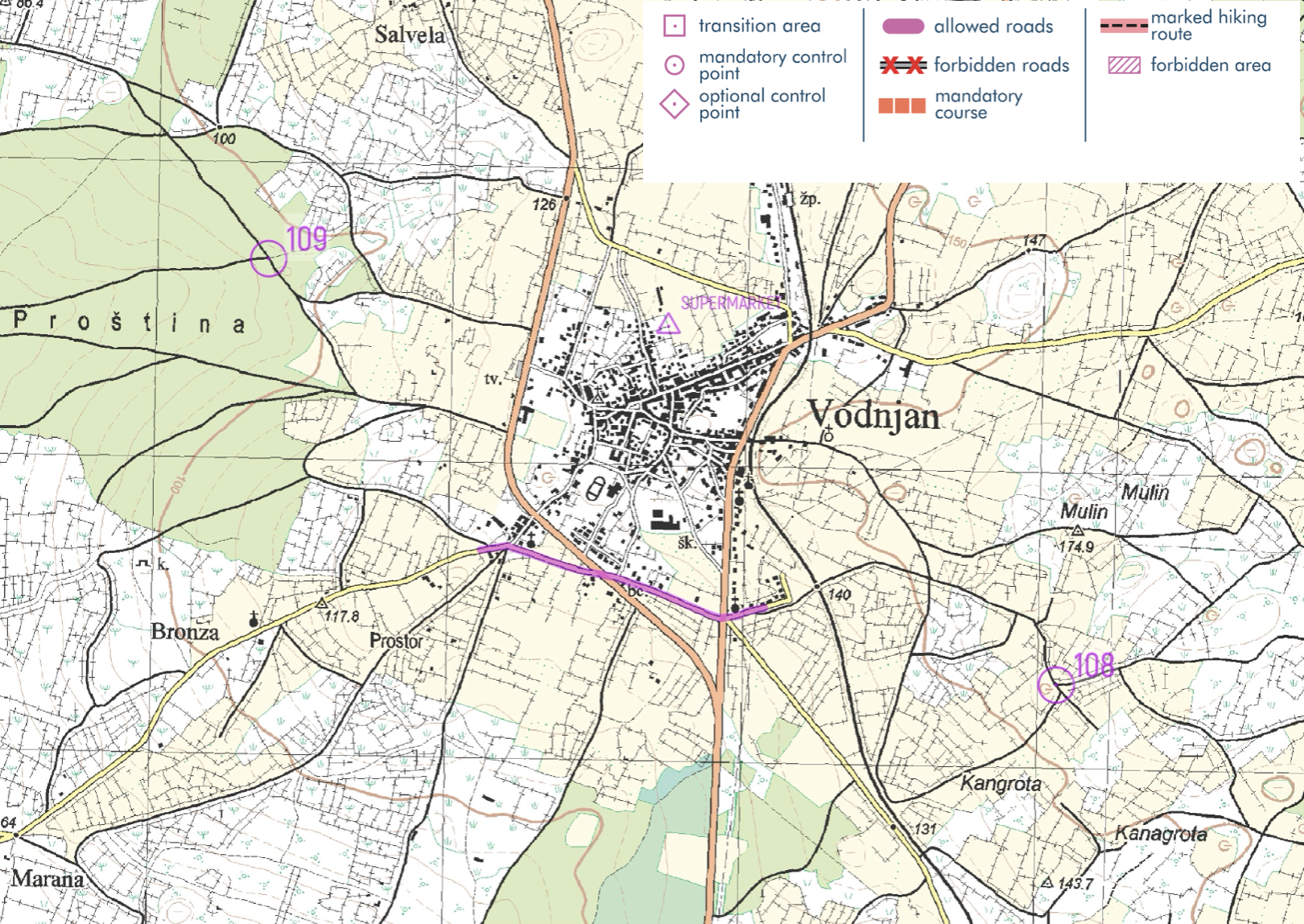
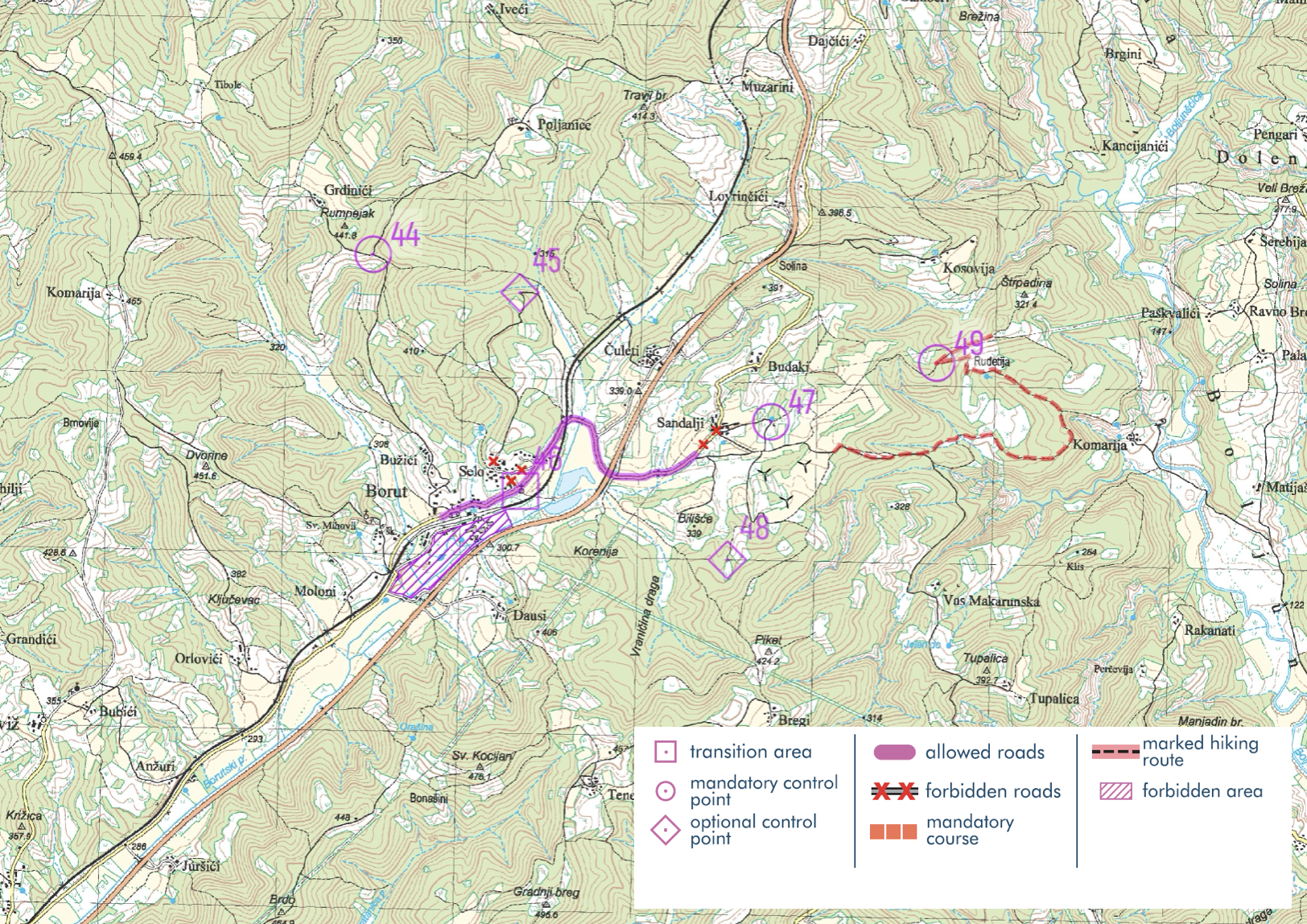
- Using or crossing the primary road (marked ORANGE) is forbidden for biking and hiking legs. Some sections of the primary roads (marked in MAGENTA) will be allowed. On some legs, the main road (marked in YELLOW) will also be forbidden. Check the map examples below in MAPS
- Each team can have one TEAM BAG. The team bag is not mandatory. More details below
-
GEAR BOX x 2
LIMIT 25 kg per box -
TEAM BAG
LIMIT 25 kg -
BIKE BOX x 4
LIMIT 25 kg -
PADDLE BAG x 2
LIMIT 25 kg per bag -
CLIMBING GEAR
NO LIMIT
- We will provide you with 2 re-supply boxes per team (approx 140 l per box).
- Only boxes supplied by the organizers may be used, teams can’t use their own re-supply boxes.
- Boxes will be available at some of the transition areas on route. You will always get your 2 boxes together, except if otherwise noted in the road book.
More info on these areas will be in the road book. - Maximum weight of the one box is 25 kg.
- Each team can have one team bag with a tent and sleeping items (sleeping bag, sleeping mat, favorite stuffed toy…).
- We suggest waterproof duffel bags cause we cannot guarantee that they will stay dry.
- Team bag will be available at some of the transition areas on route.
More info on these areas will be in the road book. - Maximum weight of the bag is 25 kg.
- The teams will have to bring their own bike boxes for safer and easier transfer during the race.
ARWS standard box size is 140 cm x 80 cm x 30 cm.
Please DO NOT bring bigger boxes. - We advise you not to use cardboard boxes or if you do try to waterproof them as best as you can.
Here is a good example of how to build your own bike box. - You can store addition gear in the bike boxes but maximum total weight can’t be over 25 kg.
- Each team must have two paddle bags. You will have to fit all your paddling gear INSIDE those two bags. Paddles must be detachable.
- Your paddle bag will be waiting for you at the beginning of every kayak or packrafting leg. You will have to transport all the gear from paddle bag including the paddle bag with you to the end of the packrafting legs. No gear should be left after you leave with packrafts.
- On the kayak legs, we will transport your paddle bags to the end of the kayak leg.
- Only gear related to water activities is permitted in the paddle bags – no food, water, extra clothes unless it is permitted by the organizer for a specific kayak/packrafting leg.
- Maximum weight of the bag is 25 kg.
We are planning on having rope sections that may include abseiling, Via ferrata or similar activities.
Gear list will be added soon.
RANKING
We have created a system that helps slower teams keep up with faster ones by allowing them to skip some checkpoints. For the top teams, nothing changes: to win, or even just to finish the Full Course, they will need to collect every checkpoint.
Two types of checkpoints
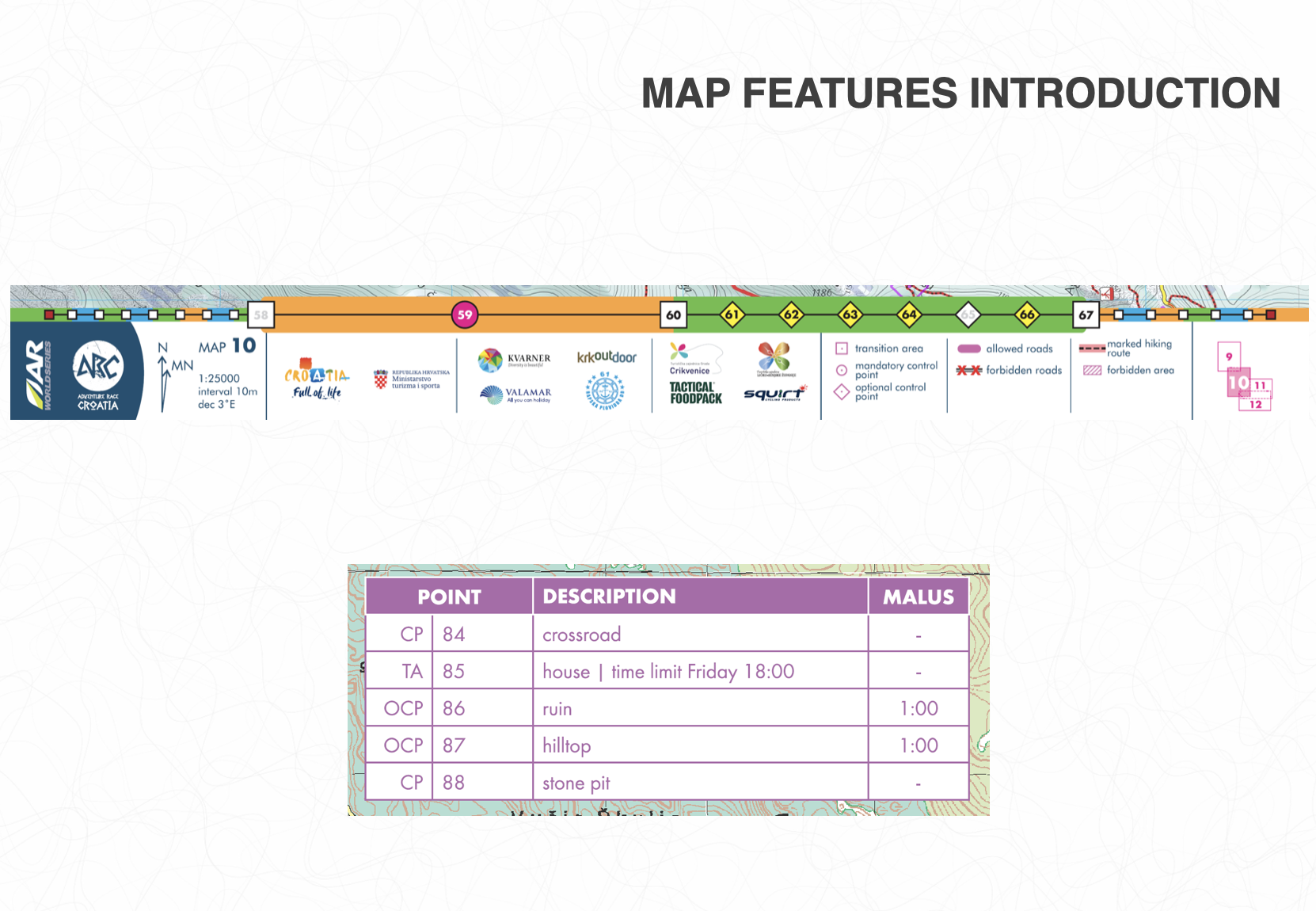
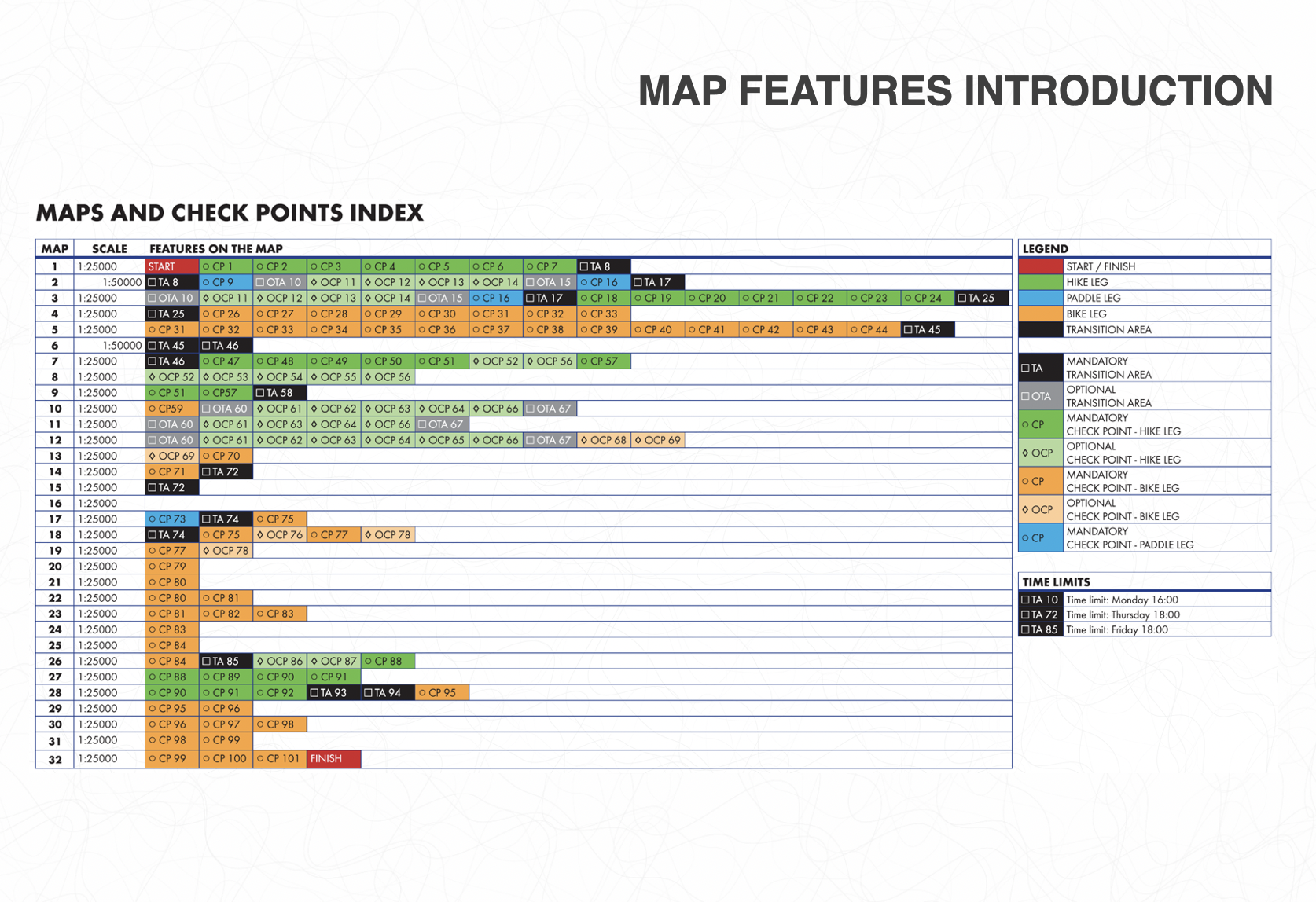
- Mandatory checkpoints (CP): teams must collect all of them to stay in the Full or Mandatory Course.
- Optional checkpoints (OCP): each has a time value, which does not always reflect how long it takes to collect. If a team skips an OCP, its time value is added to the team’s total race time. These penalties are added after the finish.
How the course categories work
- Full Course: a team that collects all checkpoints, both CPs and OCPs. The winner is the team that does this in the fastest time.
- Mandatory Course: as soon as a team misses its first OCP, it moves from the Full Course to the Mandatory Course.
- Short Course: as soon as a team misses its first CP, it moves to the Short Course.
Ranking order
Mandatory Course teams cannot be ranked above Full Course teams, and Short Course teams cannot be ranked above Mandatory Course teams.
FINAL RANKING CRITERIA
EXPLANATION & EXAMPLES
- If a team misses any OCP, it ranks below all teams that collected every mandatory and optional CP, regardless of adjusted time.
Example: Team A collected all mandatory CPs in 70 h. Team B collected all mandatory CPs in 68 h but missed one optional CP worth 1 h (total 69 h). Team A ranks higher because it collected all CPs. - If no team collects all mandatory and optional CPs, the winner is the team that collected all mandatory CPs in the fastest adjusted time.
Example: Team A collected all mandatory CPs in 70 h and missed one optional CP worth 2 h (total 72 h). Team B collected all mandatory CPs in 68 h and missed one optional CP worth 5 h (total 73 h). Team A ranks higher. - Once a team breaks its sequence of mandatory CPs, any team that collected more consecutive mandatory CPs will be ranked higher.
Example: Team A collects 34 mandatory CPs in a row, skips one, then collects 20 more. Team B collects 35 mandatory CPs in a row, skips one, then collects 16 more. Team B ranks higher. - If teams have the same number of consecutive mandatory CPs, the team with the highest total number of mandatory CPs ranks higher.
Example: Team A and Team B both collected all mandatory CPs in a row until CP 54. After that, Team A collected 9 more mandatory CPs, and Team B collected 10. Team B ranks higher.
MAPS
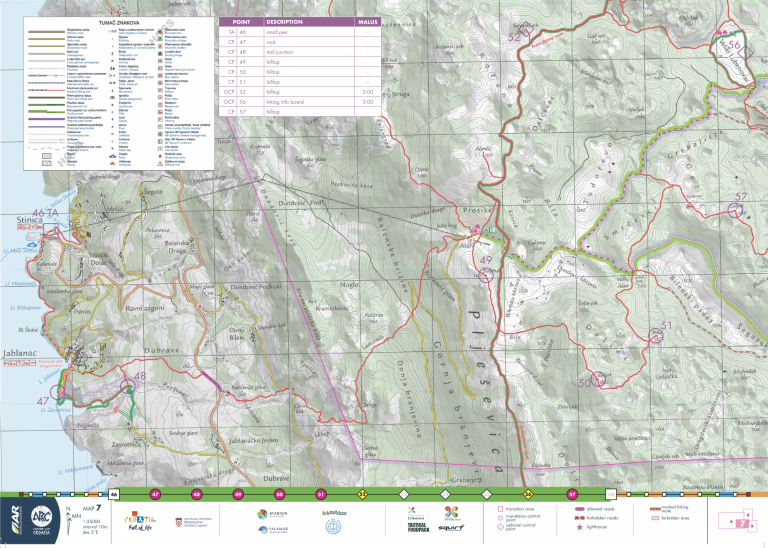
We will be using two types of maps: standard topo maps and hiking maps.
Hiking maps will include marked routes.
All maps will be at a 1:25,000 scale with CPs clearly marked.
The maps will be waterproof yet remain writable.
Each team will get two sets of maps.
STANDARD TOPO MAPS ARC 2018

HIKING MAPS ARC 2018

STANDARD TOPO MAPS ARC 2019

HIKING MAPS ARC 2019

STANDARD TOPO MAPS ARC 2022

STANDARD TOPO MAPS ARC 2022

STANDARD TOPO MAPS ARC 2023

STANDARD TOPO MAPS ARC 2023

STANDARD TOPO MAPS ARC 2024
HIKING MAPS ARC 2024
TRAVEL INFO
- AIRPORTS
- PASSPORT & VISA
- DRIVING
- CURRENCY
- ELECTRICITY
- WATER
- WEATHER
Arriving by plane?
The nearest international airport is Zadar Airport. We will organize a transfers from Zadar Airport for teams and their equipment.
We will also provide drop-off to Zadar Airport after the race. We will try to adjust the time of the drop off according to the departure of the teams but don’t expect us to be very flexible. We will definitely try our best.
We can help you with booking a transfer from other airports, so let us know by email if you need any assistance.
Croatia is a Member State of the European Union, and on 1 January 2023, it also became part of the Schengen area.
Travellers from other Schengen countries do not have to show their identity card or passport when traveling to or from Croatia if they come from countries belonging to the Schengen area. However, we advise you to bring your passport or identity card with you nevertheless, in case you need to prove your identity.
Entering Croatia from countries that do not belong to the Schengen area is possible upon presentation of an identity card, a valid passport or a valid visa. It is also important to point out that you will need your passport when requesting a VAT refund form for purchases made in Croatia if you live in a country that is not a Member State of the European Union.
Before travelling to Croatia, you can check all the details on the official website of the Ministry of Foreign and European Affairs of the Republic of Croatia. We also suggest that you contact the Croatian embassy or consulate to check the requirements before you travel.
Thanks to the enhanced mobility within the European Union, many European citizens don’t see their personal documents, including their passports, as important as they were in the past. Despite the openness of the borders and the free flow of people, you should always be careful with your personal documents because their theft or loss can cause unwanted issues or lead to identity fraud.
Should you lose your passport or identification card you used to enter Croatia, first you must seek assistance from the nearest police station, followed by the diplomatic mission or consulate of your country, where they can provide you with a temporary travel document, enabling you to exit Croatia.
- Drive on the right-hand side of the road and overtake on the left.
- Seat belts are mandatory for all occupants of the vehicle.
- Don’t drink and drive, the law has a zero-tolerance policy for drivers under 25 which means that the blood alcohol level (BAC) limit is 0%.
- The BAC limit for drivers over 25 years old is 0.5%.
- The use of a mobile phone while driving is prohibited unless you have a hands free device.
- Vehicles entering a roundabout have right of way as do all forms of public transportation and school buses.
As a member of the European Union, Croatia is part of the economic and monetary union which introduced the euro as the common currency.
As of 1 January 2023, the euro (EUR) will be the Croatian currency and the sole legal tender in Croatia, replacing the previous kuna. Banknotes are available in denominations of 5, 10, 20, 50, 100 and 200 euros, while coins of 1 and 2 euros and 1, 2, 5, 10, 20 and 50 cents are in use. There is also a 500 euro banknote in circulation, which was discontinued in 2019, but is still legal tender.
The electric energy system in Croatia is the same as in the rest of Europe. All installations emit an alternating current of 220V/50Hz, and the sockets used are type F (so-called “Schuko” sockets). This means that European visitors (except those from Great Britain and Ireland) won’t require any adapters, while visitors coming from countries with a different system or socket standard should use standard, EU adapters.
Visitors from countries whose electric energy system is based on a lower voltage (110V) should check whether their devices can function on the European 220V system. Newer devices can most probably function regardless of the type of electric energy system, but there is no harm in checking, especially in the case of more sensitive or expensive personal devices.
Yes, the water is safe to drink in Croatia. Tap water safety levels are generally high across Croatia. According to the studies, Croatian tap water is of excellent quality and meets all standards for human consumption.
Average temperatures reach a very pleasant high of around 20 – 25°C and reach a low of a very manageable 15°C.
However, weather in the mountains can change quickly and temperature could get as low as 5 °C. Also it is not unusual for temperatures to get over 30 °C.
Even with the warmer weather, the average rainfall during September is around 75mm over 10 days, so although it is likely to be generally dry and warm, there is still a risk of showers and thunderstorms during your trip.
The average sea temperature during September is 20°C.